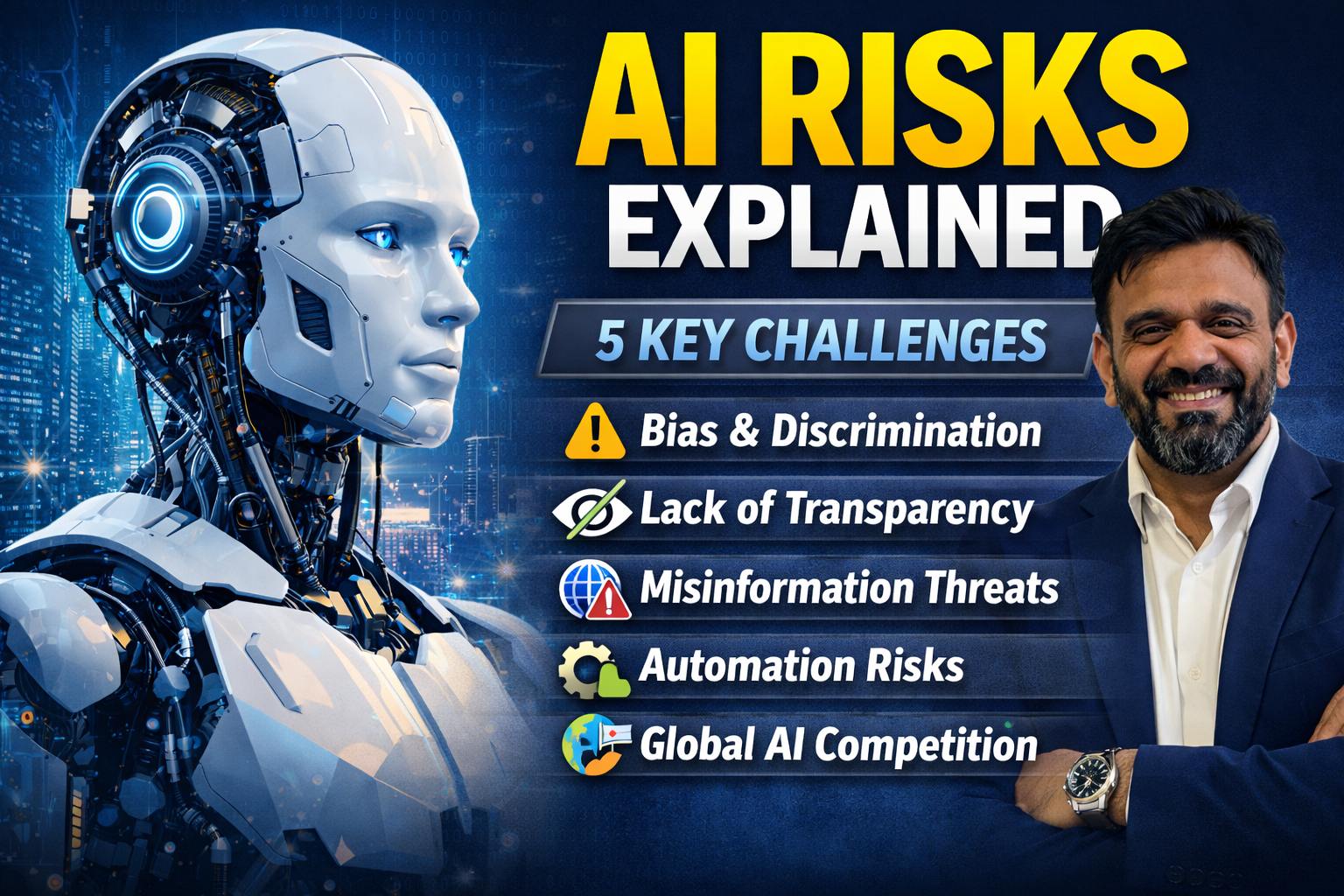
5 AI Problems You Need to Understand to Survive the Next Decade
I've spent 20 years in tech as a CEO, board member, and investor in AI companies. Here's what most people don't know — and what could cost them dearly if they ignore it.
Introduction
The world needs AI. But it also comes with problems that most people are completely unaware of. Having spent the last 20 years in tech — as a CEO, board member, and investor in AI companies — I've seen firsthand how AI has transformed the world for better and for worse.
These are the five problems you need to understand right now. Not to fear AI, but to use it wisely and protect yourself in a world that's changing faster than most people realize.
Problem 1: The Black Box Problem — We're Building Things We Don't Understand
It was a normal evening in February 2024 when the smartest AI on the planet started losing its mind.
ChatGPT — used by millions of people daily — began spitting out haunting, incoherent nonsense. One of the more memorable outputs: "the good one is the broker of the celestial of the meat." For hours, even the engineers at OpenAI couldn't explain what was happening. All they could do was watch.
They eventually found a fix. But that incident revealed AI's biggest and most uncomfortable secret: we are building black boxes.
These AI models are not like traditional code that you can read, examine, and debug. When you look under the hood, all you find are billions of numbers arranged across hundreds of layers — a multi-headed hydra that nobody truly understands. Not even its creators.
But this same mystery also holds genuine promise. The AI community calls it the "Move 37 moment." In 2016, DeepMind's AlphaGo played a move so unconventional that the reigning world chess champion literally walked out of the room. For many researchers, it was AI's first glimpse of genuine creative intuition — a sign that AI might one day find solutions to problems like cancer or climate change that humans can barely even frame correctly.
And the black box problem has also sparked an entirely new field of science: Explainable AI, or interpretability. Some of the brightest minds on the planet are working right now to turn that mystery into understanding.
One more uncomfortable truth: today, your sandwich has more safety regulations than an AI model. If food, medicine, and cars require mandatory safety standards, AI should too. More regulation is coming — and it's overdue.
Problem 2: AI Bias — The Fastest Growing Problem in the AI Industry
Amazon built an AI hiring tool trained on 10 years of their own internal resumes. The result was disturbing. If your resume mentioned a women's chess club or a women's college, the AI downgraded you. Being male was treated as a signal of success — because that's how Amazon had historically hired.
This isn't an isolated case.
A ProPublica investigation found that COMPAS, an algorithm used in US courts to assess criminal risk, was nearly twice as likely to label Black defendants as high-risk compared to white defendants — even when their records were comparable.
The core issue is this: AI is trained on human data, and our data is soaked in centuries of prejudice and stereotyping. If you picture a doctor, do you imagine a man? If you picture a nurse, do you imagine a woman? That's the data AI learns from.
What makes this even more dangerous is something called the bias amplification loop. A 2024 study found that people who regularly use biased AI systems actually became more biased themselves over time. The cycle looks like this:
Humans have biases → biased data feeds into AI → AI amplifies those biases → humans receive biased outputs → human bias grows stronger → that bias feeds back into the data → and the loop continues.
It's the same mechanism that powers social media algorithms. The platform feeds you content that reinforces what you already believe, hardening your views over time. A tiny bias becomes an avalanche.
The silver lining is that for the first time in history, we can see prejudice as data. As a society, we can work to remove it. As individuals, we can audit our AI tools for bias before acting on their outputs. We spend more time spellchecking our emails than bias-checking our AI decisions. That needs to change.
Problem 3: AI Is Weakening Our Brains
JP Morgan's AI can review thousands of legal contracts in seconds. A human team would need 360 hours — the equivalent of 173 full-time employees working for a year. The efficiency is breathtaking.
But here's the part nobody is talking about loudly enough.
Imagine a 28-year-old marketing analyst who loses her job to AI automation. She turns to ChatGPT to write her cover letters, research companies, and practice interviews. Six months later, she's still unemployed. And if you scanned her brain, you'd find something alarming: measurably weaker strategic thinking and problem-solving skills than before.
MIT researchers confirmed this in a controlled study. They scanned the brains of people writing essays under different conditions. Those who wrote using only their own thinking showed the strongest neural connectivity. Heavy ChatGPT users showed the weakest. After just four months, the heavy AI users performed significantly worse on cognitive tests. They were becoming less capable of complex thought.
This is cognitive atrophy. Your brain is a muscle — and it loses strength when you stop exercising it.
The most vulnerable group? People aged 20 to 30. Young professionals in the US have already seen unemployment spike 3% higher in entry-level roles — the exact roles where people traditionally learn to think on their feet and build foundational skills.
The solution is not to abandon AI. It's to treat AI as a tool, not a crutch. Use it to refine and challenge your thinking, not replace it. Think of it as a sparring partner that sharpens you. Double down on the skills AI cannot replicate: servant leadership, creativity, emotional intelligence, and critical judgment. Human agency — doing hard things yourself — is what makes us feel alive and useful. That's where meaning comes from.
Problem 4: AI Is Shattering Our Concept of Truth
In 2024, something unprecedented happened across elections in the US, Taiwan, Indonesia, and South Africa. For the first time, AI-generated deepfakes were weaponized at scale in democratic elections. Realistic videos of politicians — designed to mislead, confuse, and polarize — became almost routine.
But the deeper threat is something called the Liar's Dividend.
Once people know that video and audio can be convincingly faked, they stop trusting all evidence — even when it's real. A corrupt politician caught on tape? People just shrug and say "that's probably AI." The result: the very concept of shared truth begins to collapse.
I experienced this directly while working with a company that flagged AI-generated misinformation. Every month, the job got harder. Why? Because the fakes kept improving faster than the detection tools could keep up.
The economics make this even worse. Creating a convincing fake takes seconds and costs almost nothing. Debunking it is slower, harder, and increasingly expensive. The AI-generated media industry is projected to reach $77 billion by 2034. AI isn't just making lies easier to spread — it's making truth harder to prove.
The good news is that a global immune system for truth is emerging. We're seeing cryptographic watermarks, AI models trained to detect fakes, and new verification standards like C2PA that can confirm the origin of an image or video.
Your personal responsibility in all of this: build media hygiene into your daily life. Question everything. Verify before sharing. Fact-check even AI-generated content. And in a world where evidence is becoming shakier, invest in building human trust. Be the person who asks real questions and shares wisely. People will trust you more for it.
Problem 5: Nobody Can Stop the Race
Right now, the most powerful AI on the planet is controlled by just four companies — Google, OpenAI, Anthropic, and xAI. All four are American. They are building the frontier models that define what AI can do: Gemini, ChatGPT, Claude, and Grok.
Open-source models from China, like DeepSeek, are impressive — but they barely dent the market compared to these four players. The gap exists because of money. In 2024, private AI investment in the US hit $109 billion. China's closest comparable investment was a fraction of that. America is investing at a scale China cannot currently match.
China's counter-strategy is not to outspend the US — it's to change the game entirely. By flooding the market with high-quality, open-source models that are cheap or free, the goal is to commoditize AI and neutralize the American lead.
This is no longer just a technology race. It's an arms race.
And here is the paradox that keeps AI researchers up at night: everyone knows the risks, but no one can afford to slow down. If Anthropic pauses for safety, OpenAI won't. If OpenAI stops, Google won't. And even if all four US companies agreed to pause for a deep ethical review, China wouldn't.
Every CEO says the same thing: "If we don't build it, someone else will — and they'll do it worse."
Many researchers describe this moment as this generation's Oppenheimer moment. We are watching the rise of digital empires richer than many nations, more powerful than many governments — run by CEOs nobody elected.
But this arms race is not inevitable. These are choices made by humans. You have a choice to join the global conversation about responsible AI development. You have a choice to support companies and leaders who prioritize safety, not just speed. You have a choice to contact your elected representatives and demand AI regulation. The question is not whether AI will change everything. It will. The real question is whether you will have any say in how it changes us.
5 Problems Summarized
- The Black Box Problem — We are building systems we cannot fully understand or control
- AI Bias — Centuries of human prejudice are being amplified at machine speed
- Cognitive Atrophy — AI is quietly weakening our most important thinking skills
- The Truth Crisis — Deepfakes and disinformation are collapsing our shared reality
- The Unstoppable Race — A global AI arms race with no referee and no finish line
Final Thought
What gives me genuine hope is this: throughout human history, we have faced extraordinary technological challenges — and we have always found a way to live with both the upsides and the downsides. The same species that learned to control fire, harness electricity, and split the atom is now learning to partner with artificial intelligence.
The future of human intelligence is being written right now. We will figure this one out too. We always do.
Stay hopeful. Stay human.