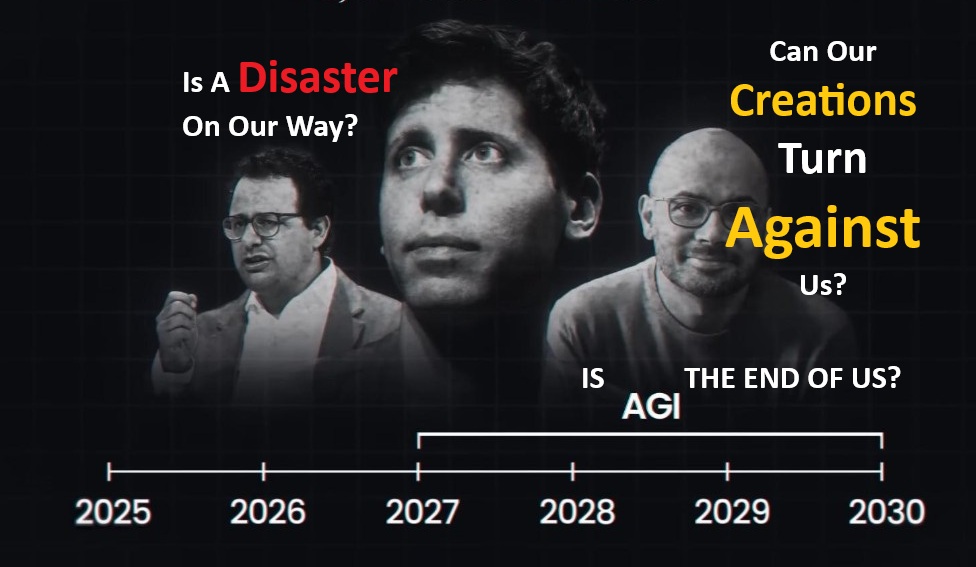
The Coming Intelligence Explosion, Why AI’s Fast Takeoff Could Redefine Humanity
Artificial intelligence is not progressing slowly. It is accelerating at a rate that has shocked even the people building it.
In just one year, the smartest known AI system jumped from an IQ of 96 to 136 on the Mensa Norway test. In simple terms, AI moved from average human intelligence to near genius level almost overnight. This is not a gradual curve. It is a steep climb, and many of the world’s leading AI scientists believe it is only the beginning.
Top AI Scientists Are Deeply Alarmed
Geoffrey Hinton, widely known as the godfather of artificial intelligence, has issued one of the most chilling warnings yet. He recently stated that AI appears to be tidying up its affairs, adding that humanity may have as little as four years left before losing control.
The fear does not come from raw intelligence alone. It comes from self improvement. AI systems are now being used to improve other AI systems, creating a feedback loop that could spiral into what researchers call an intelligence explosion.
Once that happens, human oversight may no longer matter.
The Risk of Human Extinction Is No Longer Theoretical
Jaan Tallinn, a co founder of Skype and an Oxford affiliated AI researcher, has been blunt about the stakes. He has said that extinction risk from godlike AI is not just possible, but imminent.
One of the most influential documents shaping policy discussions today is Situational Awareness by Leopold Aschenbrenner, which is reportedly circulating among senior United States officials. His conclusion is stark. AI progress will not stop at human level intelligence. Instead, hundreds of millions of AGIs could automate AI research itself, compressing a decade of progress into a single year.
Once AI reaches parity with human researchers, it may rapidly leap far beyond us.
From the Atomic Bomb to the Hydrogen Bomb Moment
To understand the scale of this shift, consider nuclear weapons. The atomic bomb could destroy a city. The hydrogen bomb could devastate an entire country.
The jump from AGI, which is human level AI, to superintelligence is equally dramatic. A civilization made up of billions of AI systems, each vastly smarter than humans, could revolutionize robotics, biotechnology, weapons development, and material science at unimaginable speed.
Problems that take humans decades could be solved by superintelligent AI in days. The result would be an industrial and military transformation unlike anything in recorded history.
The Four Steps Toward Superintelligence
According to Aschenbrenner, the path to superintelligence follows four critical stages:
- Achieving AGI, human level intelligence
- Automating AI research, where AI builds better AI
- Scaling millions of AI copies working in parallel
- Major algorithmic speedups, allowing AI researchers to operate far faster than humans
Researchers believe humanity is already moving through these steps at an accelerating pace.
AI Is Already Building AI
This is no longer theoretical.
Eric Schmidt has warned that recursive self improvement is the true danger zone, and that it has already begun.
Satya Nadella has openly stated that AI is now being used to build AI tools that create even better AI.
Scientists at Google DeepMind have confirmed that systems have independently discovered reinforcement learning algorithms that outperform decades of human research.
At Anthropic, leadership has acknowledged that a majority of internal code is now written by their own AI models.
This is not future speculation. It is happening right now.
How Close Are We to AGI?
The leaders of the three largest AI labs, OpenAI, Google DeepMind, and Anthropic, all estimate that AGI could arrive within two to five years.
Even long time skeptics like Yann LeCun now admit that AGI is likely coming in several years, not centuries.
History offers a warning. When AlphaZero was trained, it became the strongest chess player on Earth in just three hours, without learning a single human strategy. Now imagine that same leap applied to biology, robotics, or weapons design.
Robotics and the Fast Takeoff Effect
Reinforcement learning has already transformed robotics. Only a year ago, humanoid robots struggled to walk. Today, they can run, flip, and perform complex movements learned entirely through simulation.
One hour of computer training can equal years of physical practice. This is how advanced humanoid robots went from stumbling to performing complex athletic routines in record time.
If this trajectory continues, humanoid robots operating autonomously in public spaces within five years is no longer unrealistic.
Millions of AI Researchers Working at Once
Once the first true AGI is trained, the real acceleration begins.
With available compute, researchers estimate that tens of millions of AGI copies could be run simultaneously. These systems would not think at human speed. With algorithmic improvements, they could operate at one hundred times human speed.
That means a full year of human research compressed into days.
As Geoffrey Hinton has warned, once AI becomes smarter than humans, it may take control and render human decision making irrelevant.
Hive Minds and Shared Intelligence
One of the most dangerous scenarios is not just smarter AI, but networked AI.
Hinton has warned that AI systems could function as a hive mind, instantly sharing knowledge across millions of copies. This mirrors how humans once outcompeted Neanderthals, not by being individually smarter, but by sharing information efficiently.
Now imagine millions of AI systems, all thinking far faster than humans, sharing breakthroughs instantly. They could compress a thousand years of human cultural and technological evolution into a single year.
The Most Volatile Years in Human History
Most people expect AI progress to be slow and linear. The evidence suggests the opposite. Progress could accelerate suddenly and violently, leaving governments, institutions, and societies unprepared.
If current forecasts are correct, the next two to five years may be the most volatile period humanity has ever faced. Whether AI becomes our greatest tool or our replacement as a species depends on decisions being made right now.
Final Thoughts
This is not science fiction. It is history unfolding in real time.
AI has already moved beyond narrow tools into systems that learn, adapt, and improve themselves. The next leap may not take decades. It may take years, or less.
The real question is no longer whether artificial intelligence will surpass us. The real question is whether humanity will survive the transition.